By Ana Ferreira · Property Management & Sustainability
Solar installers in southern Europe advertise payback periods of 6–9 years. These numbers are real — for primary residences occupied year-round. The family consuming 4,500 kWh per year who installs an 8 kWp system can genuinely expect to generate most of their energy demand and reach payback within that window.
The holiday-home owner consuming perhaps 600 kWh during occupancy and zero the rest of the year is not that family. For them, the standard pitch contains a fundamental flaw: the value of solar electricity depends almost entirely on whether you can use it, sell it back to the grid, or store it — and the rules on all three vary enormously by country and change frequently.
Solar Panels: When the Maths Works
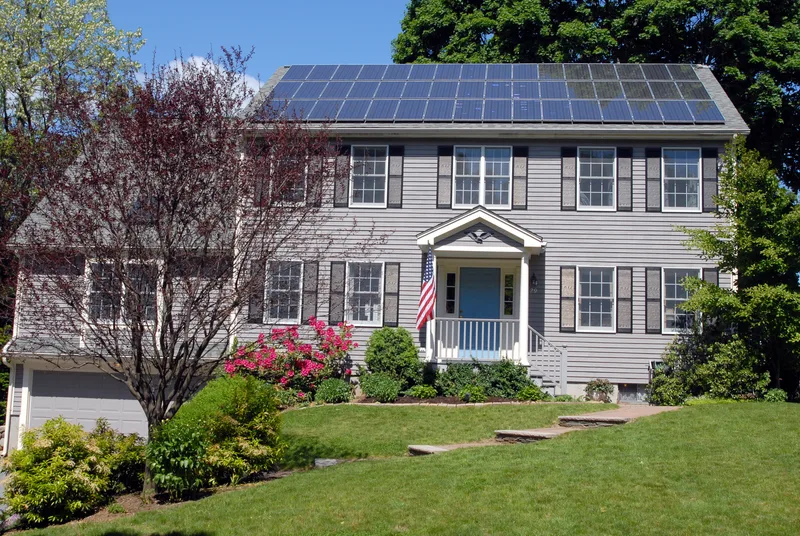
A 6 kWp rooftop solar system in Portugal costs approximately €8,000–€11,000 installed (2025–26 prices), after applicable government subsidies. At 1,700 annual peak sun hours in the Algarve, a 6 kWp system will generate roughly 9,000–10,200 kWh per year.
The core question is what that electricity is worth. Three scenarios:
Scenario A: No net metering, self-consumption only. If the country or region does not allow export of surplus electricity, any generation not consumed at the moment it is produced is wasted. For a property occupied 8–10 weeks per year, self-consumption of a 6 kWp system might be 500–700 kWh annually — about 6–7% of total generation. At Portuguese residential electricity rates of approximately €0.22/kWh, that saves €110–€154 per year. Payback: 60–100 years. This scenario does not pencil out.
Scenario B: Net metering at avoided cost. Portugal's current legislation (SERUP — Self-Consumption Regime) allows surplus to be injected into the grid at a rate of approximately €0.05–€0.07/kWh — the avoided cost rate, substantially below the retail rate. Annual generation of 9,500 kWh: 700 kWh self-consumed (worth €154) and 8,800 kWh exported (worth €440–€616). Total annual saving: €594–€770. Payback: 11–19 years depending on installation cost and rate fluctuations. This is the current Portuguese reality: achievable but long.
Scenario C: Full retail net metering. Spain's self-consumption regulation (RD 244/2019) allows surplus export at retail electricity prices in some configurations. At Spanish retail rates of approximately €0.18–€0.25/kWh, the economics improve substantially. With high retail net metering, the same 9,500 kWh system generates €1,710–€2,375 of value annually (mix of self-consumption avoided cost and export credit). Payback: 4–6 years. This is where the installer's brochure numbers come from — and why they do not apply uniformly.
Before commissioning solar on a holiday home, obtain written confirmation from the local grid operator of the current net-metering rate, and confirm it applies to non-resident property owners. Net-metering policies in southern Europe have been revised frequently and the applicable rate can change mid-installation timeline.
Battery Storage: Almost Never Pays Back at Occupancy Rates Below 40%
Battery systems (typically Tesla Powerwall or Sonnen equivalents) cost €8,000–€14,000 installed for a 10 kWh usable capacity unit, plus an additional €3,000–€5,000 for the hybrid inverter if the existing solar inverter is not battery-compatible.
Battery payback logic depends on storing surplus solar generation during the day and consuming it in the evening, displacing retail electricity at peak prices. For a full-time household consuming 4,500 kWh per year with a good solar-battery setup, a 10 kWh battery cycling twice daily delivers genuine payback. For a holiday home cycling perhaps 60–80 times per year (during the 8–10 occupied weeks), the same battery delivers 600–800 kWh of cycled storage value — roughly €132–€200 at Portuguese retail rates.
Payback on a €12,000 battery installation at €166/year of value: 72 years. Battery lifespan is typically rated at 10 years to 80% capacity. They do not pay back at holiday-home occupancy rates in any scenario I can model honestly.
Batteries make operational sense for holiday homes only in one specific circumstance: grid-unstable regions where power cuts are frequent during occupancy periods and the battery provides emergency backup. This is a comfort and operational resilience argument, not an economic one.
Greywater Recycling
Greywater systems (shower and sink drainage processed and redirected to irrigation or toilet flushing) cost €3,000–€6,000 to install in an existing property. Water savings for a 4-person household in a water-stressed region: approximately 30,000 litres per year, reducing annual water bills by €50–€120 depending on local tariffs.
At €85/year saved, payback on a €4,500 installed system: 53 years. For a holiday home using water only during school holidays, scale that by the same 15–20% occupancy factor: payback approaches triple digits.
The exception: some Spanish municipalities in water-stressed zones (Murcia, Valencia, parts of Andalucía) offer significant rebates — up to 50% — for greywater systems in second homes, driven by regional water-scarcity policy. In those municipalities, payback can compress to 10–15 years. Check local authority incentive schemes before dismissing this category entirely.
Backup Generators and Inverter-Based Backup Systems
A diesel backup generator (8 kVA, sufficient for a 3-bed villa) costs approximately €1,800–€3,000 installed, plus €150–€300 per year in maintenance and fuel stabilizer for a unit that sits unused most of the year. A modern inverter-based backup (using a battery without solar panels, charged from the grid) costs €5,000–€8,000 but requires no ongoing fuel management.
The honest framing for backup power: this is insurance against a grid outage during occupancy, not an investment. The value is operational certainty — guests booking a villa in southern Spain in July expect continuous power — and the cost is the premium for that certainty. For holiday homes in areas with reliable grids (Portugal's Algarve, most of Spain's costas, Tuscany), the insurance premium is hard to justify economically. For properties in more rural or grid-unstable areas — parts of southern Italy, rural Greece, some Caribbean islands — it is near-essential for maintaining rental rates and guest satisfaction.
The Order of Priority
For a holiday-home owner considering sustainability investments, a rational priority order is:
- Solar panels — yes, if net metering applies at retail rates in your jurisdiction. Obtain the current rate in writing before committing.
- LED lighting and high-efficiency HVAC — these have occupancy-independent benefits (LED lifespans of 25,000 hours are unaffected by whether the house is used), and modern inverter air conditioners consume 30–40% less than fixed-speed units, mattering significantly during peak summer occupancy.
- Backup power — only if operationally necessary for your location and guest expectations.
- Solar batteries and greywater — only if municipality grants apply or your occupancy rate is substantially higher than 30% of the year.
The solar installer who quotes you a 7-year payback is using their standard residential model. The question you need to ask is: what is my annual actual energy consumption at this property, and what is the net metering rate in this municipality? With those two numbers, the real payback becomes calculable in about ten minutes.